(c) One day you are playing a card game with one friend. Suppose there are 191 cards in total. You and your friend take turns
to draw 1 to 5 cards once. The one who draws the last card will lose the game. Suppose you always draw the cards first, and
your friend is wise enough. Design a winning strategy and proof that you can always win.
Answers:
We may consider different cases at the end of the game. When 2 cards remain, and it is my turn to take cards, I can
take 1, and the opponent is left with 1 card, therefore losing the game. Similarly, when 3 cards remain, I can take 2 and
leave 1. This winning position goes on until there are 7 remaining cards, where, no matter how many cards I take, he
will be in the winning position as the case reduces to 1 to 6 remaining cards. Therefore, when the party who is left with
7 cards to draw must lose the game. When there are 8 cards remaining, I can take 1 card to reduce it to 7 and force my
opponent on the losing position. Similarly, when there are 9 remaining, I take 2, ..., until there are 12 remaining for
me and I take 5 to make it 7. Again, if I am left with 13 cards, no matter how many I take, it will reduce to 8 to 12
remaining cards, and my opponent can always make sure that I am left with 7 cards, thus losing.
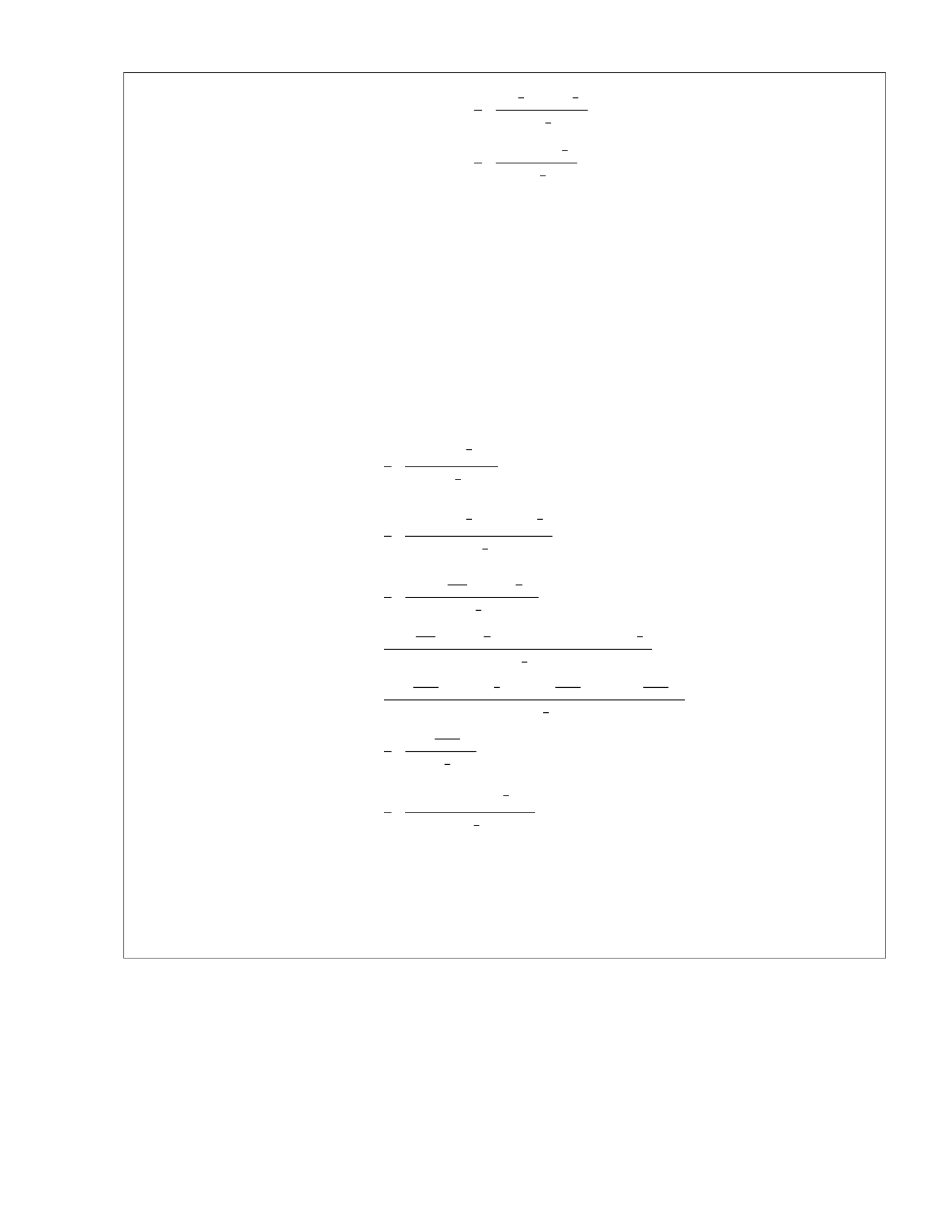
From the above discussion, we can observe that if we can ensure the opponent is left with 6𝑛 + 1 cards to take where
𝑛 ∈ Z
+
, we can always win. Therefore, we can come up with this strategy:
Strategy: I first take 4 cards, so that the opponent is left with 191 − 4 = 187 = 6 × 31 + 1 cards. Suppose the opponent
then take 𝑝 ∈ [1, 5] cards in each round, I take (6 − 𝑝) cards, and repeat until the game ends.
Now we formally prove this strategy.
Proof:
Denote 𝑃(𝑛) : “When there are (6𝑛 + 1) cards remaining, the player who make a step from this state by taking 𝑝
cards must lose if the opponent takes (6 − 𝑝) cards.” We prove ∀𝑛 ≥ 1 : 𝑃(𝑛).
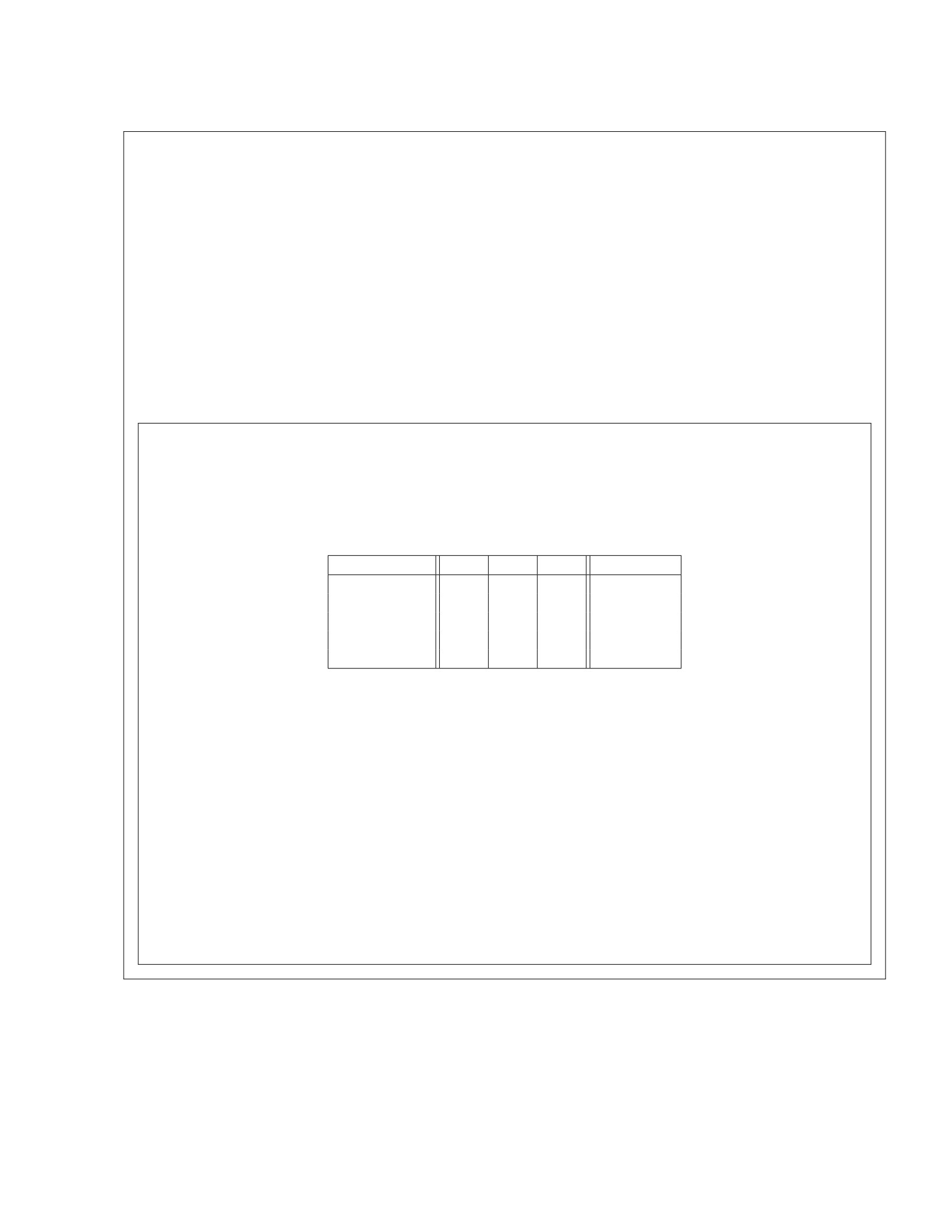
Base case: 𝑃(1) (i.e. 7 remaining cards). In the table below, the columns 𝑃 record number of cards taken by
the player making a move from the state of (6𝑛 + 1) cards, columns 𝑂 record the opponent. The numbers in the
brackets denote the cards remaining.
P O P Result of P
𝑷(1) : Case 1 1 (6) 5 (1) 1 (0) Lose
𝑷(1) : Case 2 2 (5) 4 (1) 1 (0) Lose
𝑷(1) : Case 3 3 (4) 3 (1) 1 (0) Lose
𝑷(1) : Case 4 4 (3) 2 (1) 1 (0) Lose
𝑷(1) : Case 5 5 (2) 1 (1) 1 (0) Lose
Therefore, regardless how many cards the player takes, he will always lose if the opponent is playing optimally.
Therefore, 𝑃(1) holds.
Inductive Step: Assume that for some 𝑘 ≥ 1, 𝑃(𝑘) holds. Consider 𝑃(𝑘 + 1), that is, we have [6(𝑘 + 1) + 1] cards
remaining. When compared with 𝑃(𝑘), we have [6(𝑘 + 1) + 1] − (6𝑘 + 1) = 6𝑘 + 7 − 6𝑘 − 1 = 6 more cards.
Observe that in each round, the player takes 𝑝 cards, and the opponent takes (6 − 𝑝) cards, removing a total of
𝑝 + (6 − 𝑝) = 6 cards. Then, after one round from 𝑃(𝑘 + 1), the number of remaining cards reduces by 6, reducing
the case back to 𝑃(𝑘), which is assumed to hold.
Therefore, we have 𝑃(𝑘) ⇒ 𝑃(𝑘 + 1).
By the principle of mathematical induction, 𝑃(𝑛) holds for all 𝑛 ≥ 1.
Now, integrate this 𝑃(𝑛) with our strategy. We first take away 4 cards, leaving 187 remaining cards, which
corresponds to the 𝑃(31) case. Since we have shown ∀𝑛 ≥ 1𝑃(𝑛), then 𝑃(31) must hold. And notice that after we
take the initial 4 cards, it is the opponent who starts to make a move from this state, therefore, the opponent must
lose, i.e., I must win.
Q.E.D.
Page 6 of 10