COMP1110-Project-Plan
File description: The project plan for COMP1110 (25/26 Spring).
Document status: FIN
Last modified: 2026-09-11 21:12 HKT



PROJECT PLAN FOR THE COURSE COMP1110 – GROUP D08
CHUN HEI BANH, SZE POK LIU, ZHAN HO JACOB SHING, YUBING YE, AND YIKUN ZHANG
1. Topic Selection & Introduction
The group has selected the topic B. Smart Public Transport Advisor for the
project. For the project, the group will implement a route planner with the focus for
pedestrian navigation within the campus of The University of Hong Kong (HKU). To
achieve that, the group will model the campus as an undirected multigraph as defined
mathematically by:
(1) G = (V, E),
where for each vertex v ∈ V , v represents a key location on the campus, such as a building
entrance, a canteen, etc.; and for each edge e ∈ E represents an undirected path between
two distinct vertices. In addition to the graph structure, each edge will have a set of
attributes, such as the average walking time, type of path (e.g., slope, stairs, etc.), etc.
The details of what attributes to include will be determined during the design phase of
the project.
2. Review of Existing Solutions
For researching purposes, the group will review three types of existing solutions, each
with two examples:
(1) General purpose route planners: Google Maps, Citymapper;
(2) Transportation-specific route planners: MTR Mobile App, HKBUS.app;
and
(3) Static navigation systems: HKU campus map, On-campus navigation sig-
nages.
The examples will be evaluated across several dimensions, such as easiness of use, speci-
ficity for pedestrian navigation, etc. The conclusions drawn from the comparison shall
be used to fine-tune the design of our own route planning implementation.
3. Task Decomposition, Assignments & Timeline
The project will be decomposed into three phases: Research & Design, Implemen-
tation, and Case Study, Test, & Evaluation, each with its dedicated tasks. Each task
has a defined timeline and expected deliverables, which will be detailed in the following
subsections.
3.1. Task decomposition. The tasks, along with their descriptions, expected deliver-
ables, and time estimates, are listed in Table 1.
Date: 21 March 2026.
1
Page 1 of 5
2 C. BANH, S. LIU, J. SHING, Y. YE, AND Y. ZHANG
Table 1: A list of tasks for accomplishing the project, along with their descriptions,
expected deliverables, and time estimations.
Task ID Phase Description Expected Deliverables
Time
(days)
R01 Research & Design
Survey existing navigation solutions and
compare them in a table format.
Comparison table of existing tools (target
users, key features, missing features, etc.)
with summary takeaways.
3
R02 Research & Design
Problem modeling for our solution: define
core entities, input/output, and coverage
scope.
Documentation of core concepts (stop,
segment, journey, etc.), input/output
specifications, scope of coverage.
1
I01 Implementation
Data collection: assign responsible areas to
each team member, measure and record
paths between designated nodes.
Collected path data (distance, time, cost,
etc.), raw measurement records or data
sheets.
7
I02 Implementation Coding: basic data structures in Python.
Implemented data structure classes (e.g.,
Graph, Node, Edge) with methods for
serialization, deserialization, and basic
operations.
3
I03 Implementation
Coding: text-based application UI with
main functionality for selecting
origin/destination and preferences.
A text-based user interface (based on
Textual) for user to choose
origin/destination and preferences, with
backend integration for route planning.
10
I03A Implementation
Coding: data management UI for
interactive data collection and editing.
(Optional) Interactive data management
tool supporting CRUD operations on data.
5
I04 Implementation
Coding: route search logic (candidate
generation, scoring, ranking).
Route search algorithm code, find the
optimal itinerary based on the user’s
selected preferences (such as cost, duration,
number of segments).
5
Continued on next page.
Page 2 of 5
PROJECT PLAN 3
Table 1. Continued from last page.
Task ID Phase Description Expected Deliverables
Time
(days)
I05 Implementation Coding: advanced preference mode.
An algorithm that can avoid stairs, or pick
routes that are accessibility-focused, etc.
3
C01
Case Study, Test, &
Evaluation
Scenario design: write 3 to 4 user scenarios
with goals, network layout,
origin/destination, and preference modes.
Document describing 3 to 4 user scenarios. 2
C02
Case Study, Test, &
Evaluation
Record input/output for scenarios. Run the
program for each scenario and capture
results.
Input parameters and program outputs for
each scenario.
1
C03
Case Study, Test, &
Evaluation
Analyze the competence of our solution and
compare with existing solutions.
Analysis report on solution capabilities,
comparison with existing tools.
2
C04
Case Study, Test, &
Evaluation
Discussion and suggestions: summarize
strengths, limitations, and future
improvements.
Discussion document with limitations
analysis and improvement directions.
2
Page 3 of 5

4 C. BANH, S. LIU, J. SHING, Y. YE, AND Y. ZHANG
Table 2. The tasks as defined in Table 1 and their assignees. Asterisk (*)
indicates the person has been assigned to the task.
Task ID
Assignee
C. Banh S. Liu J. Shing Y. Ye Y. Zhang
R01 * *
R02 * * *
I01 * * * *
I02 * * * *
I03 * * * *
I03A * * * *
I04 * * * *
I05 * * * *
C01 * *
C02 * * *
C03 * *
C04 * *
3.2. Task assignments. The task assignments are listed in Table 2.
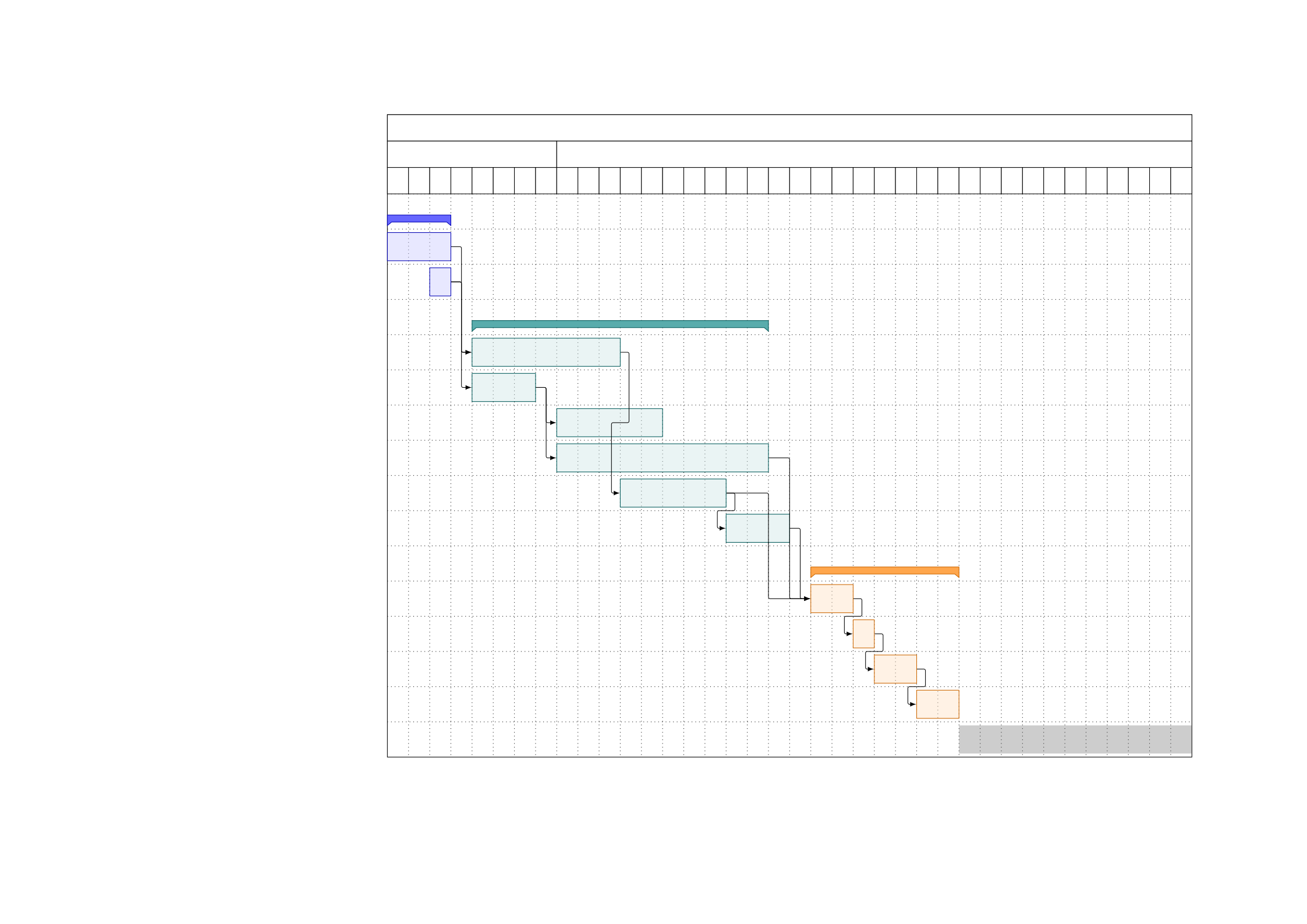
3.3. Plan timeline. Note that the tasks set out in Table 1 are not necessarily executed
sequentially and linearly. They may be arranged in parallel where possible and appro-
priate. The timeline for the project and the dependency of tasks are illustrated by the
Gantt chart in Figure 1.
The timeline is merely a rough estimation and may be adjusted as the project pro-
gresses. There is a buffer period at the end of the project to accommodate any unforeseen
delays or additional work that may arise during the project execution.
Page 4 of 5
PROJECT PLAN 5
Project Timeline
Mar Apr
24 25 26 27 28 29 30 31 01 02 03 04 05 06 07 08 09 10 11 12 13 14 15 16 17 18 19 20 21 22 23 24 25 26 27 28 29 30
Research & Design
R01 – Survey
R02 – Design
Implementation
I01 – Data collection
I02 – Write data classes
I03A – Write data management UI
I03 – Write text UI
I04 – Write route search logic
I05 – Write advanced preference mode
Case Study, Test, & Evaluation
C01 – Scenario design
C02 – Run scenarios and record results
C03 – Analyze solution capabilities
C04 – Discussion and suggestions
Buffer
Figure 1. The Gantt chart illustrating the project execution.
Page 5 of 5
See also
-
COMP1110-Project
The GitHub repository of the group project.
-
COMP1110-Project-IndividualReport_JacobShing
Individual report for COMP1110 (25/26 Spring) by Jacob Shing.
-
COMP1110-Project-Report
The project report for COMP1110 (25/26 Spring).
-
COMP1110-Quiz
The final quiz for COMP1110 with 50 multiple-choice questions, solutions, and explanations.
-
CCCH9044-Individual-Essay
The 3000-word individual essay for the course CCCH9044.
-
CCGL9042-Question-Bank
The question bank for CCGL9042 in-class quizzes.